
The famous Charles Bridge crosses the Vltava River in Prague

The thirteenth century Charles Bridge is typically full of tourists and Czechs alike, particularly throughout the spring and summer months. Charles Bridge surely ranks because the most vital tourist attractions within the town and may be the primary item on your list of sights to examine. Early morning is that the best time to expertise a less crowded walk, though a romantic evening walk through the impressively lit streets of Prague by night is sweet too. Expect many memento stands additionally as an endless kind of street musicians taking part in their hearts out for you as you stroll across. However, aren't getting too frantic by the pleasures as a result of you may simply have your pockets picked

The famous Charles Bridge crosses the Vltava River in Prague. This 'solid-land' association created Prague vital as a trade route between east and west Europe. The bridge was originally referred to as the Stone Bridge or the Prague Bridge however has been the "Charles Bridge" since 1870.

King Charles IV's favorite architect and builder Peter Parler, originally engineered the present-day bridge. The initial plan was to create a purposeful construction for jousting tournaments, and for several years the sole decoration on the bridge was a straightforward crucifix, however later the will of the Catholics for ornamentation resulted in thirty statues being engineered (1600 to 1800 AD).

Today most of the statues are copies, because of harm caused by varied floods and catastrophes over the centuries. There are currently seventy five statues and maybe the foremost attention-grabbing, and oldest, is that of John Nepomuk (no. eight from the correct as you cross towards the castle). The Bridge, that is 516 meters long, contains sixteen pillars and three bridge towers. one in all the towers, the previous city Bridge Tower, is taken into account to be the foremost lovely bridge tower in Europe because of its wealthy sculptural decoration. Thirty sculptures that beautify the bridge date mainly from the baroque amount - from the eighteenth century. the foremost exceptional was one created by Matyas Braun and E. M. Brokoff.

John Nepomuk was a priest in Prague below Wenceslas IV. sadly for John Nepomuk, Wenceslas was a suspicious man. One fateful day, the priest received the confession of the attractive queen. However, Wenceslas was convinced she had told the priest a few suspected love affair, whereupon he demanded rather unsympathetically to understand what the Queen had revealed. The priest, being of pious blood, didn't break his commitment of confidentiality to the wonder in question and consequently was hauled over the bridge to drown within the Vltava. However, all wasn't lost for shortly a golden halo appeared over the spot within the Vltava where he disappeared as proof of his martyrdom, and hence these days there's a hoop of golden stars over his head on the statue. a number of meters in front of the particular statue, there's atiny low crucifix marking the spot where he was thrown from the bridge. bit the crucifix and your want can return true!

The Tower of London in England

The Tower of London, founded by William the Conqueror in 1066 has Outstanding Universal price for the subsequent cultural qualities:
Its landmark siting, for each protection and management of the town of London: because the gateway to the capital, the Tower was in result the gateway to the new Norman kingdom. Sited strategically at a bend within the River Thames, it's been an important demarcation purpose between the facility of the developing town of London, and therefore the power of the monarchy. It had the twin role of providing protection for the town through its defensive structure and therefore the provision of a garrison, and of additionally controlling the voters by constant means that. The Tower literally ‘towered’ over its surroundings till the nineteenth century.

As a logo of Norman power: The Tower of London was designed as an illustration of Norman power. The Tower represents quite the other structure the far-reaching significance of the mid 11th-century Norman Conquest of England, for the impact it had on fostering nearer ties with Europe, on English language and culture and in making one among the foremost powerful monarchies in Europe. The Tower has an iconic role as reflecting the last military conquest of England.
As an excellent example currently 11th-century innovative Norman military architecture: because the most complete survival of an 11th-century fortress palace remaining in Europe, the White Tower, and its later thirteenth and 14th century additions, belong to a series of edifices that were at the leading edge of military building technology internationally. They represent the apogee of a sort of refined castle style, that originated in Normandy and unfold through Norman lands to England and Wales.

As a model example of a Medieval fortress palace that evolved from the eleventh to sixteenth centuries: The additions of Henry III and Edward I, and significantly the highly innovative development of the palace at intervals the fortress, created the Tower into one among the foremost innovative and influential castle sites in Europe within the thirteenth and early 14th centuries, and far of their work survives. Palace buildings were added to the royal advanced right up till the sixteenth century, though few currently stand higher than ground. The survival of palace buildings at the Tower permits a rare glimpse into the lifetime of a medieval monarch at intervals their fortress walls. The Tower of London may be a rare survival of a continuously developing ensemble of royal buildings, evolving from the eleventh to the sixteenth centuries, and as such has nice significance nationally and internationally.

For its association with State institutions: the continual use of the Tower by successive monarchs fostered the event of many major State establishments. These incorporated such elementary roles because the nation’s defence, its records, and its coinage. From the late thirteenth century, the Tower was a significant repository for official documents, and precious merchandise owned by the Crown. The presence of the Crown Jewels, kept at the Tower since the seventeenth century, are a reminder of the fortress’s role as a repository for the Royal Wardrobe.

As the setting for key historical events in European history: The Tower has been the setting for a few of the foremost momentous events in European and British History. Its role as a stage upon that history is enacted is one among the key parts that have contributed towards the Tower’s standing as an iconic structure. Arguably the foremost vital building of the Norman Conquest, the White Tower symbolised the would possibly and longevity of the new order. The imprisonments within the Tower, of Edward V and his younger brother within the fifteenth century, and then within the sixteenth century of 4 English queens, 3 of them executed on Tower inexperienced – Anne Boleyn, Catherine Howard and Jane gray – with solely Elizabeth I escaping, formed English history. The Tower additionally helped form the Reformation in England, as each Catholic and Protestant prisoners (those that survived) recorded their experiences and helped outline the Tower as an area of torture and execution.

A monument symbolic of royal power since the time of William the Conqueror, the Tower of London served as an excellent model throughout the dominion from the top of the eleventh century. Like it, several keeps were in-built stone: e.g. Colchester, Rochester, Hedingham, Norwich, or Carisbrooke Castle on the Isle of Wight.

The White Tower is that the example par excellence of the royal Norman castle within the late eleventh century. The ensemble of the Tower of London may be a major reference for the history of medieval military design.

roon inside the Tower of London

Travel The Dead Sea

The Dead ocean, not like the ocean of Galilee to the north, doesn't figure prominently within the biblical narratives. Its most vital role was as a barrier, blocking traffic to Judah from the east. An advancing army of Ammonites and Moabites apparently crossed a shallow a part of the Dead ocean on their thanks to attack King Jehoshaphat (2 Chron 20). Ezekiel has prophesied that sooner or later the Dead ocean are going to be contemporary water and fishermen can unfold their nets along the shore.

The Dead ocean is found within the Syro-African Rift, a 4000-mile fault line within the earth's crust. the bottom purpose of dry land on earth is that the shoreline of the Dead ocean at 1300 feet below ocean level. That the lake is at the bottom purpose means water doesn't drain from this lake. Daily seven million loads of water evaporate however the minerals stay, inflicting the salt content to extend. Figures for the Dead Sea's salinity nowadays vary from 26-35%.

Nearly 10 times as salty because the world's oceans and twice as saline because the nice Salt Lake in Utah, the Dead ocean is made with minerals. The Dead ocean Works company on the southwest aspect of the lake employs 1600 individuals round the clock to reap the precious minerals from the water. Potash is that the most dear of these extracted nowadays and is employed within the manufacture of fertilizer. the most effective article on the minerals within the Dead ocean is within the Encyclopedia Britannica.

The distinctive concentration of the Dead ocean waters has long been known to possess medicinal worth. Aristotle, Queen of Sheba, King Solomon and Cleopatra were all at home with this and trendy doctors similarly usually prescribe patients with skin ailments to soak within the waters of the Dead ocean. due to the dropping level of the Dead ocean, the southern finish is not any longer below water, aside from that that is channeled by aqueducts for the aim of extracting minerals.

The Goeltzschtal Bridge

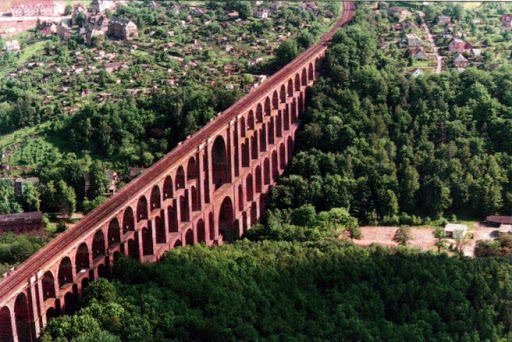
The Goeltzschtal Bridge (or Goeltzschtalbrucke, to convey it its true name) has been photographed many thousands of times across the decades. This outstanding construction standing within the Vogtland region of Germany is 574 m long, with four tiers of arches stacking to seventy eight m high, creating the Goeltzschtalbrucke the world's largest bridge designed of bricks.
A true masterpiece of engineering, the Goeltzschtal Bridge was in-built the mid 1800s, when the age of the railway was at its most pioneering. the simplest route for the new railway link between Leipzig and Nuremberg meant that 2 bridges required to be designed, one in every of that should span the Goltzsch Valley (the different being the Elster Valley).
In January 1845 the railway company launched a contest, inviting styles for a bridge to cross the Goeltz Valley. though quite eighty submissions were received, none of them met the required needs. The result was that one in every of the competition's eminent panel of judges, Prof. Johann Schubert, really proposed the successful style.
As there have been insufficient native provides of natural materials, like sandstone or granite, it absolutely was set that bricks be used. Bricks were conjointly seen as a more cost-effective various, that was a major issue, only if the bridge's construction concerned twenty six million of them.
Professor Schubert's style proposed an impressively tall viaduct comprising four levels, every with individual arches of even proportions. A year once his set up was accepted, the inspiration stone was laid.
Difficulties occurred too soon within the bridge's construction. When excavations got underway for the pillar that was to act as a central support, engineers discovered that the soil was unable to require its weight. the development plans thus had to be amended, that means that, rather than having identical arches, the bridge had 2 giant openings, with every arch spanning thirty one metres.
Thousands of builders worked on making the Goeltzschtal Bridge and, as was sadly thus usually the case with constructions around this era, accidents were an everyday incidence. Over 1300 men were injured and thirty one lost their lives.
The Goeltzschtal Bridge was officially opened on fifteen July 1851 and formally handed over to the railway company who had commissioned its style. The Elstertal Bridge, usually said as its very little sister, is that the second largest of its kind, containing twelve million bricks.
More than a hundred and fifty years once its construction, the Goeltzschtal Bridge continues to hold the railway and its eighty one arches are still captured by several an awe-inspired photographer.

photophotophoto

Travel The Aqueduct of Segovia in Spain

The Aqueduct of Segovia may be a Roman aqueduct and one in all the foremost important and best-preserved ancient monuments left on the Iberian Peninsula. it's the foremost image of Segovia, as evidenced by its presence on the city's coat of arms.

As the aqueduct lacks a legible inscription , the date of construction can't be definitively determined. Researchers have placed it between the second 1/2 the first Century AD and therefore the early years of the 2nd Century throughout the reign of either Emperor Vespasian or Nerva. The beginnings of Segovia itself are likewise not definitively known. The individuals known as Vaccaei are known to own populated the world before the Romans conquered town. Roman troops sent to regulate the world, that fell among the jurisdiction of the Roman provincial court located in Clunia, stayed behind to settle there.

The aqueduct transports waters from Fuente Fría river, situated within the nearby mountains, some seventeen km from town in an exceedingly region called La Acebeda. It runs another fifteen km before arriving within the town.

The water is initial gathered in an exceedingly tank called El Caserón , and is then led through a channel to a second tower called the Casa de Aguas .

There it's naturally decanted and sand settles out before the water continues its route. Next the water travels 728 m on a one-percent grade till it's high upon the Postigo, a rocky outcropping on that the previous town center, the Segovia Alcázar, was built. Then, at Plaza de Díaz Sanz , the structure makes an abrupt flip and heads toward Plaza Azoguejo . it's there the monument begins to show its full splendor. At its tallest, the aqueduct reaches a height of twenty eight.5 m , together with nearly half-dozen m of foundation.

There are each single and double arches supported by pillars. From the purpose the aqueduct enters town till it reaches Plaza de Díaz Sanz, it boasts seventy five single arches and forty four double arches, followed by four single arches, totalling 167 arches in all.

The construction of the aqueduct follows the principles laid out by Vitruvius as he describes in his De Architectura printed within the mid-first century.

The first section of the aqueduct contains thirty six semi-circular arches, rebuilt within the fifteenth century to revive a little destroyed by the Moors in 1072.

The line of arches is organized in 2 levels, adorned merely, within which predominantly straightforward moulds hold the frame and supply support to the structure. On the higher level, the arches have a complete width of five.1 meters . inbuilt 2 levels, the highest pillars are each shorter and narrower than those on the lower level. the highest of the structure contains the channel through that water travels, through a U-shaped hollow measuring zero.55 by 0.46 meters. The channel continuously adjusts to the bottom height and therefore the topography below. The lower-level arches have an approximate width of four.5 meters Their pillars gradually increase in circumference size. the highest of every pillar features a cross-section measuring one.8 by 2.5 meters , whereas the bottom cross-section measures approximately a pair of.4 by three meters .


Principal facade of the Aqueduct of Segovia.
The aqueduct is constructed of unmortared, brick-like granite blocks. throughout the Roman era, every of the 3 tallest arches displayed a symptom in bronze letters, indicating the name of its builder beside the date of construction. Today, 2 niches are still visible, one on either side of the aqueduct. one in all them is thought to own held the image of Hercules, who in keeping with legend was founding father of town. the opposite niche currently contains the photographs of the Virgen de la Fuencisla and Saint Stephen.

The first reconstruction of the aqueduct happened throughout the reign of the King Ferdinand and Queen Isabella, called the Reyes Católicos or Catholic Monarchs. Don Pedro Mesa, the previous of the nearby Jerónimos del Parral monastery, led the project. a complete of thirty six arches were rebuilt, with nice care taken to not modification any of the initial work or vogue. Later, within the sixteenth Century, the central niches and above-mentioned statues were placed on the structure. On four December, the day of Saint Barbara, who is that the patron saint of artillery, the cadets of the native military academy drape the image of the Virgin in an exceedingly flag.

The aqueduct is that the city's most vital architectural landmark. It had been kept functioning throughout the centuries and preserved in glorious condition. It provided water to Segovia, mainly to the Segovia Alcázar, till recently. thanks to differential decay of stone blocks, water leakage from the higher viaduct, and pollution that caused the granite ashlar masonry to deteriorate and crack, the location was listed within the 2006 World Monuments Watch by the globe Monuments Fund. Contrary to fashionable belief, vibrations caused by traffic that used to pass below the arches didn't have an effect on the aqueduct as a result of its nice mass. WMF Spain brought along the Ministry of Culture, the regional government of Castilla y León, and different native establishments to collaborate in implementing the project, and provided help through the worldwide money services company yank specific.